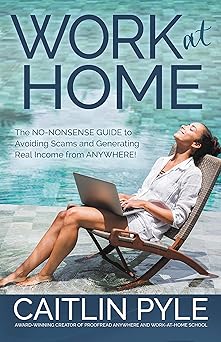
Earn Income From Home: A Complete Guide to Remote Jobs, Side Hustles, Online Business & Freelancing—Step-by-Step Work Plans, Tools & Templates to Help You Build Flexible Income is a practical career and entrepreneurship guide by Jennifer Westley and the first book in The Earn & Thrive from Home Series.
The book is aimed at people who want to earn money without being tied to a traditional workplace. Rather than focusing on one particular career path, Westley takes a broad approach, covering remote employment, freelancing, side hustles, and online businesses.
That broad approach is one of the book's biggest strengths.
The modern work-from-home economy offers an enormous number of possibilities, but that can also create a problem: there are so many choices that beginners often don't know where to start. One person might be interested in a remote job, another might want freelance clients, while someone else might want to create an Etsy store or digital business.
Westley's book attempts to bring these possibilities together into one accessible guide.
What Is Earn Income From Home About?
At its core, Earn Income From Home is about turning the desire for flexible income into a practical plan.
The published description emphasizes several major areas:
Freelancing
Side hustles
Online businesses
Digital businesses
E-commerce opportunities
Work-from-home planning
Finding legitimate opportunities
Avoiding scams
Creating applications and pitches
Developing income gradually
The book is particularly focused on beginners. Its stated purpose isn't simply to provide a giant list of ways to make money online. Instead, it attempts to explain how someone can select an opportunity, prepare for it, and take concrete steps toward earning.
That distinction is important.
There are countless books and websites promising that readers can make easy money from home. The problem is that many of those promises leave out the difficult parts: developing skills, finding customers, applying for jobs, marketing yourself, dealing with rejection, and consistently producing useful work.
Westley's approach appears considerably more grounded.
The publisher's description specifically emphasizes avoiding "easy money" traps and identifying legitimate opportunities, which is an important theme for anyone entering the work-from-home marketplace.
A Practical Approach to Working From Home
One of the most appealing aspects of this book is its practical orientation.
According to the published description, the book includes step-by-step work plans, tools, templates, checklists, worksheets, and planning resources.
That makes sense for the subject.
A person who wants to start freelancing doesn't necessarily need another motivational speech. They need to know what to do next.
For example, a beginner may need to:
Choose a service
Create a professional profile
Develop examples of their work
Find potential clients
Set reasonable rates
Complete the first assignment
Collect testimonials
Improve their service
A good work-from-home book should help turn that sequence into manageable tasks.
Earn Income From Home appears designed around exactly that philosophy.
Remote Jobs
Remote employment is one of the major subjects covered by the book.
Remote jobs can be attractive because they offer many of the benefits of traditional employment while eliminating the daily commute. Depending on the position, remote workers may be able to work from their home office, maintain a more flexible schedule, and reduce transportation expenses.
However, finding a legitimate remote job can be considerably more difficult than many advertisements suggest.
There is tremendous competition for desirable remote positions. Employers may receive large numbers of applications for a single opening.
This means that simply searching for "work from home jobs" isn't enough.
Applicants need to understand how to present their experience, customize applications, identify appropriate positions, and recognize fraudulent employment offers.
The book's emphasis on avoiding scams is therefore particularly relevant.
The Importance of Avoiding Work-From-Home Scams
This is arguably one of the most important subjects for any book about earning money online.
Work-from-home scams have existed for decades, but the internet has made it much easier for dishonest operators to reach potential victims.
Some scams involve fake employment opportunities. Others involve supposed business opportunities that require large upfront payments.
Common warning signs include requests for money before employment begins, promises of enormous income with little effort, pressure to act immediately, vague descriptions of the actual work, and requests for sensitive personal information before a legitimate hiring process has occurred.
A beginner who is excited about working from home can be particularly vulnerable.
A useful guide therefore needs to teach readers not just how to find opportunities, but how to evaluate them.
Westley's emphasis on recognizing red flags is one of the strongest elements of the book's overall concept.
Side Hustles
The side-hustle portion of the book is another area that should appeal to a broad audience.
A side hustle is fundamentally different from a traditional job.
A job generally involves working for an employer in exchange for wages or salary. A side hustle can involve selling services, products, creative work, digital products, or other forms of value directly to customers.
The advantage is flexibility.
Someone with a full-time job might be able to spend a few hours each evening developing a small business. Over time, that small operation could potentially become a meaningful source of additional income.
However, there is an important reality that prospective readers should understand.
A side hustle isn't automatically passive income.
Most successful side businesses require time, effort, learning, experimentation, and persistence.
That makes the book's emphasis on work plans especially useful.
Instead of simply asking, "What can I do to make money?" readers should eventually be asking:
"What can I consistently do that somebody is willing to pay me for?"
That is a much better question.
Freelancing
Freelancing is another major component of the book's subject matter.
Freelancing can be one of the most accessible ways for someone with a marketable skill to begin earning independently.
Potential freelance services can include writing, editing, graphic design, virtual assistance, bookkeeping, programming, research, social media management, video editing, transcription, customer support, and numerous other services.
The major advantage of freelancing is that you don't necessarily have to build an entire company before finding your first customer.
You can start with one service.
The challenge is finding clients.
This is where templates and pitch scripts can become valuable. The book's published description specifically mentions pitch scripts and other practical resources.
For a beginner, having a starting framework can eliminate some of the uncertainty surrounding client outreach.
Online Business
Westley also addresses the broader world of online business.
This category is enormous.
An online business could mean an e-commerce store, digital products, content creation, services, print-on-demand products, an Etsy business, consulting, affiliate marketing, or many other models.
One of the advantages of a broad guide like this is that readers can compare different models rather than assuming there is only one way to make money online.
The downside is that a book covering such a large subject cannot realistically provide the same depth as a dedicated book about a single business model.
Someone who wants to build a sophisticated e-commerce company will eventually need more specialized information.
The same is true for someone who wants to become a professional freelancer or launch a major digital-product business.
I therefore see Earn Income From Home primarily as a starting point and roadmap rather than the final book someone will ever need on entrepreneurship.
Etsy and Digital Businesses
The published description specifically mentions launching an Etsy shop or digital business.
This is an interesting inclusion because digital businesses can potentially have lower startup costs than many traditional businesses.
Digital products can include templates, printable materials, educational resources, graphics, guides, planners, and other downloadable products.
However, low startup costs don't mean guaranteed success.
The major challenge is discovering what customers actually want and then getting those customers to notice your products.
Competition can be substantial.
A successful digital business therefore requires more than simply creating something and uploading it.
Product selection, presentation, pricing, customer research, marketing, and continual improvement all matter.
A beginner reading Westley's book should therefore view these business models as possibilities rather than guarantees.
The First $100
One particularly sensible idea presented in the book's published description is the concept of working toward the first $100 rather than immediately expecting thousands of dollars.
This is an excellent psychological framework.
Someone who has never earned money online may find the idea of making $1,000 per month overwhelming.
The first $100 is different.
It represents proof of concept.
Once someone earns the first $100, they can analyze what worked.
Perhaps they discover that a particular service is in demand.
Perhaps they discover that customers are willing to pay more than expected.
Perhaps they realize they need better marketing.
The next goal might then be $250.
Then $500.
Then $1,000.
This incremental approach is considerably more realistic than the "get rich quickly" mentality found in some corners of the online-business world.
Tools and Templates
The inclusion of tools and templates is one of the book's strongest selling points.
The published material associated with the book describes resources such as résumés, pitch scripts, checklists, worksheets, and planning dashboards.
These resources can make a practical difference because many beginners get stuck before they ever start.
They may know that they need a résumé but don't know how to structure it.
They may understand that they need to contact potential clients but don't know what to say.
They may have an idea for a business but don't know how to organize their first month.
Templates don't eliminate the work, but they can reduce the friction involved in getting started.
Is the Book Beginner Friendly?
This is where the book appears particularly strong.
The available descriptions repeatedly characterize it as practical, straightforward, beginner-friendly, and action-oriented.
That makes it potentially useful for people who have never worked remotely or operated an online business before.
A complete beginner could approach the book as a roadmap.
More experienced entrepreneurs, however, may find some of the material familiar.
Someone who has already been freelancing for years probably doesn't need an introduction to the basic concept of finding clients.
Similarly, an established online-business owner will probably require more specialized material.
The target audience is therefore important.
This is much more appealing as a first work-from-home guide than as an advanced entrepreneurship manual.
What I Like About the Book
The biggest strength is its breadth.
Westley doesn't lock the reader into a single method of earning money.
Instead, the book recognizes that different people have different skills, schedules, financial circumstances, and goals.
Someone might prefer employment.
Someone else might want freelancing.
Another person might want a side hustle.
Another might want to build a business.
The book's practical orientation is another major advantage.
The inclusion of worksheets, templates, checklists, and planning resources suggests that the author wants readers to actually do something with the information rather than simply read it.
The emphasis on scams is also valuable.
Too many work-from-home discussions focus exclusively on potential income while ignoring the risks.
A realistic guide should discuss both opportunity and risk.
Finally, I like the gradual-income philosophy suggested by the book's emphasis on moving from the first $100 toward larger monthly income goals.
That is much more sensible than promising instant financial freedom.
Potential Weaknesses
The book's greatest strength can also be its greatest limitation.
It covers a lot of ground.
Remote employment, freelancing, side hustles, e-commerce, Etsy, digital businesses, and online entrepreneurship are enormous subjects individually.
No single introductory book can explore all of them at an advanced level.
Readers who want deep instruction in one specific field will eventually need additional resources.
Another limitation is that the online employment environment changes quickly.
Job platforms, AI tools, freelance marketplaces, business software, algorithms, and online marketplaces continually evolve.
A work-from-home guide should therefore be viewed as a framework rather than a permanent directory of every opportunity.
The principles are more durable than individual websites, platforms, or tools.
Who Should Read This Book?
I would recommend Earn Income From Home primarily to:
People looking for their first remote job
Beginners interested in freelancing
People looking for a side hustle
Workers wanting additional income
People considering an Etsy or digital business
Individuals exploring entrepreneurship
People who don't know which online income model to choose
Readers who want structured work plans
Beginners who need templates and checklists
People concerned about work-from-home scams
It may be less appropriate for experienced entrepreneurs who already have established businesses and sophisticated marketing systems.
Who Probably Shouldn't Buy It?
If you are already successfully running an online business, have extensive freelancing experience, and understand remote employment strategies, you may find portions of the book too introductory.
Likewise, someone looking for a single highly specialized subject may be better served by a dedicated book about that particular field.
For example, someone who specifically wants to become a professional copywriter could benefit more from a comprehensive copywriting book.
Someone wanting to build a large e-commerce operation would probably need specialized business, marketing, advertising, and accounting resources.
Earn Income From Home works best as a broad starting point.
How Useful Is It for Someone Starting From Scratch?
This is probably where the book delivers its greatest value.
Starting from zero can be intimidating.
There are thousands of websites, job boards, platforms, business models, courses, tools, and social-media gurus competing for attention.
A beginner can easily spend months researching without actually earning anything.
The value of a structured guide is that it can help reduce that paralysis.
Instead of trying everything, a reader can choose one path and begin testing it.
That is a much healthier approach.
The goal shouldn't be to build five businesses simultaneously.
The goal should be to find one realistic income-producing activity and get good at it.
A Book About Action Rather Than Fantasy
The biggest question I would ask when evaluating any work-from-home book is whether it encourages action.
Earn Income From Home appears to pass that test.
Its emphasis on work plans, templates, worksheets, résumés, pitches, checklists, and practical steps indicates that the intended experience isn't simply inspirational reading.
It is meant to be used as a workbook and roadmap.
That is exactly how I would recommend approaching it.
Don't read the book and then put it on a shelf.
Take notes.
Choose one income path.
Create a plan.
Set a small financial goal.
Start.
Adjust.
Repeat.
That process is far more likely to produce useful results than endlessly consuming information about making money online.
Overall Assessment
Earn Income From Home by Jennifer Westley is a broad, practical introduction to the many ways people can pursue income from home.
Its greatest strengths are its accessibility, broad coverage, practical orientation, and emphasis on taking concrete steps.
The book doesn't appear to promise a magical shortcut to wealth. Instead, its central philosophy is much more useful: identify legitimate opportunities, choose a path that fits your circumstances, develop the necessary skills, take action, and gradually build income.
The inclusion of practical resources is particularly attractive for beginners.
The available audiobook edition is approximately 6 hours and 43 minutes long, and the title is listed as Book 1 in The Earn & Thrive from Home Series.
There is also evidence of positive early reception for the audiobook, although the available ratings and reviews are still relatively limited compared with long-established books. Audible listings include positive comments describing the material as practical, clear, actionable, and useful for beginners.
Final Rating: 4.5 Out of 5 Stars
Earn Income From Home is a worthwhile choice for anyone who wants to explore remote work, freelancing, side hustles, or online entrepreneurship but isn't sure where to begin.
Its greatest value isn't that it provides one magical formula for making money.
Its value is that it gives readers multiple possible paths and encourages them to turn those possibilities into an organized plan.
For a beginner, that can be extremely valuable.
The most important lesson is ultimately simple: earning money from home is possible, but it is still work. Success generally comes from providing something people genuinely need, developing useful skills, finding customers or employers, and consistently delivering value.
If you approach Earn Income From Home with that mindset, rather than expecting instant passive income, it has the potential to be a useful starting point for building a more flexible working life.